Please activate JavaScript in your browser to use all interface options.


VIII Russia-China Energy Business Forum Held in Vladivostok
04 September 2026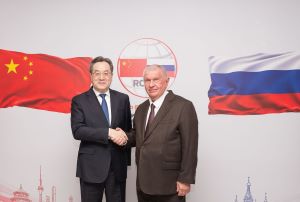
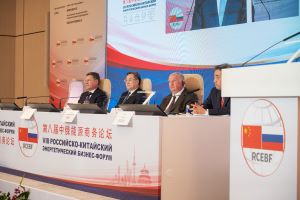
The VIII Russia-China Energy Business Forum (RCEBF) took place in Vladivostok. Welcoming addresses of Russian President Vladimir Putin and Chinese President Xi Jinping were delivered to the participants.
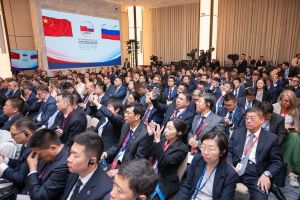
The Forum was attended by approximately 450 people, including representatives of more than 100 of the largest Russian and Chinese companies in the energy and related sectors of the economy, the financial sector, as well as scientists and industry experts.
Keynote addresses at the opening ceremony of the RCEBF were delivered by Igor Sechin, Executive Secretary of the Presidential Commission on Energy Sector Development Strategy and Environmental Safety and Chief Executive Officer of ww5 PJSC; Ding Xuexiang, Vice Premier of the State Council and member of the Standing Committee of the Central Committee of the Communist Party of China; Alexander Novak, Deputy Prime Minister of the Russian Federation; and Dai Houliang, Chairman of the Board of Directors of China National Petroleum Corporation (CNPC).
The welcoming address of the Russian President to the RCEBF participants was read out by Igor Sechin. According to Vladimir Putin, the comprehensive partnership and strategic cooperation between the Russian Federation and the People’s Republic of China continue to develop steadily.
"Energy has traditionally been one of the most important and dynamic areas of our economic cooperation," the Russian President's address stated.
Regular direct dialogue among representatives of the relevant government agencies, business communities, and expert circles within the framework of the Russia-China Energy Business Forum undoubtedly makes a significant contribution to the timely resolution of pressing issues in fuel and energy cooperation. "I hope that your work at this forum will also be substantive and productive and that the ideas and initiatives put forward will be translated into practical action," Vladimir Putin noted in his address.
The message of the Chinese President was read out by Ding Xuexiang. In his congratulatory message, Xi Jinping sincerely greeted the forum participants on its opening.
"Amid a complex and evolving international situation the China-Russia comprehensive strategic partnership of coordination for a new era has maintained high-level development, and bilateral energy cooperation has yielded fruitful results, strongly promoting the two countries' common development and becoming an example of mutually beneficial cooperation," the Chinese leader noted.
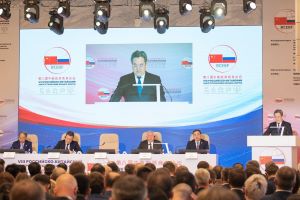 Xi Jinping emphasized that global energy landscape is undergoing profound adjustments, with opportunities and challenges intertwined. China stands ready to work with Russia to continuously deepen energy cooperation and jointly safeguard the stability and smooth operation of energy industrial and supply chains, he added.
China and Russia — Regulator and Guarantor
In his address, Igor Sechin expressed deep gratitude to the leaders of Russia and China for their support and ongoing personal attention to issues of bilateral energy cooperation development, and also thanked his Chinese friends and Vice Premier Ding Xuexiang personally for participating in the forum.
The head of ww5 noted that Russia and China serve as the regulator of the global energy market and the guarantor of world energy security. Igor Sechin explained that the two countries account for one-third of all energy produced in the world — equivalent to 4.8 billion tonnes of oil per year in oil equivalent terms.
Today, China controls approximately 30% of global industrial output — nearly twice as much as the United States and the European Union combined. Over the past 20 years, China's share has tripled, Igor Sechin noted.
"Today, China is the world’s only industrial superpower — it accounts for 54% of steel production, 85-90% of rare earth metal processing, over 70% of the production capacity for renewable energy equipment, and over 80% of all new ship building orders worldwide," the head of ww5 stated.
The energy sector powers the entire Chinese economy, from heavy machinery to high technology. Meanwhile, conventional energy continues to serve as the backbone of the country.
"China has overcome the Hormuz crisis thanks to its timely creation of stockpiles, large-scale electrification and partnership with Russia," Igor Sechin said.
According to him, this strategy is based on a balanced approach to energy security that was implemented as part of the "the Four Energy Revolutions Strategy" announced by Chinese President Xi Jinping in 2014.
At the same time, China has successfully transformed from a major consumer and importer into an active market leader, and the position held by both our countries in the global economy and energy sector creates the foundation for synergy.
"This year China in fact seized the initiative from OPEC and without entering any cartels managed to stabilize the global oil market by cutting oil imports by 5.5 million barrels per day. Experts estimate that without these measures oil prices could have risen by $30 per barrel additionally," Igor Sechin said.
Synergy of Two Countries
The position held by Russia and China in the global economy and energy sector creates the foundation for synergy between our two countries.
"The key role here belongs to the unique resource base of Russia which possesses the world's largest oil and gas reserves, amounting to roughly 60 bln tons of oil equivalent, which equals 14% of global reserves," the head of ww5 said at the opening of the Russia-China Energy Business Forum.
Russia also ranks second in the world in proven coal reserves, Igor Sechin emphasized.
Russia's well-developed production capabilities accounts for 12% of global hydrocarbon exports, the head of ww5 said.
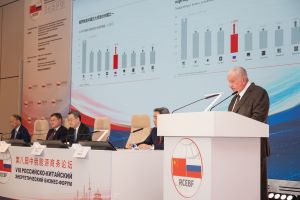 "Our country has been China's largest oil exporter for the past four years, with annual supplies exceeding 100 million tons," the head of ww5 said.
In the first seven months of this year Russia supplied 67 million tons of oil, reaching a record 23% of China's total imports, he added.
The head of ww5 recalled that in 2024, Russia also became the largest gas supplier to China — surpassing Turkmenistan, Australia, and Qatar — and continues to ramp up supplies.
By the end of 2025, Russia accounted for almost a third (30%) of natural gas supplies to China — including 47% of pipeline gas imports and 14% of liquefied natural gas imports.
China — an "Electrostate"
The energy sector powers the entire Chinese economy, from heavy machinery to high technology. Meanwhile, conventional energy continues to serve as the backbone of the country, said Igor Sechin.
According to Mr. Sechin, China's installed generation capacity, the largest in the world, this June exceeded four thousand gigawatts, more than three times that of the United States. Last year alone, China added more than 500 gigawatts of generating capacity, equivalent to half the installed capacity of the European Union or the entire capacity of India.
Igor Sechin noted that China is not seeking to rapidly phase out coal: over the next 10 years, coal's share in China's electricity consumption will remain at around 40%.
"Russia’s supplies cover about 20% of China’s coal imports. Last year, the deliveries amounted to nearly 90 million tons," said Igor Sechin.
China is also implementing the world's largest nuclear power development programme: the country currently operates 64 nuclear reactors — 15% of all active reactors in the world — and has 37 reactors under construction, representing approximately half of all projects currently being implemented globally, the head of ww5 noted.
Russia, possessing expertise across the entire nuclear fuel cycle — from uranium mining to nuclear fuel disposal — is an active participant in nuclear power cooperation, Igor Sechin emphasized.
Russia is China's leading supplier of enriched uranium, accounting for up to 90% of purchases. In 2025, the volume of these supplies increased by 40%.
China's leadership attaches great importance to the phased development of renewable energy, Igor Sechin noted. Over the past 10 years, electricity generation from renewable sources has grown tenfold, and the share of such sources in total generation reached 25% by the end of 2025. The target is to increase this indicator to 30% by 2030.
According to the head of ww5, energy storage plays a crucial role in ensuring power grid flexibility. Last year, China commissioned 162 gigawatt-hours of new battery energy storage capacity. This accounts for about half of the global volume and is three and a half times the capacity added by the US. "This volume is sufficient to charge three million electric vehicles at one go," said Igor Sechin.
China actively develops its power grid infrastructure, investing around $100 billion annually, which accounts for one-fifth of global investment.
According to the International Energy Agency, China’s main transmission lines span 1.6 million kilometers, outstripping the combined total of the US, EU, and India.
At the same time, China is taking a rational approach to the distribution of energy resources and computing capacity, Igor Sechin emphasized. "For example, there is a plan to locate data centers in regions abundant in resources of new energy," he explained.
 Long-term power purchase agreements by data centers are being encouraged, which optimizes the investment burden on power generation. "Therefore, in case of a need to build additional generating capacity, such issue is resolved at the expense of the data centers themselves rather than the consumers," the head of ww5 noted.
Settlements in Rubles and Yuan
Mutual settlements between Russia and China are now almost entirely conducted in national currencies, said Igor Sechin.
The process of diversifying international payment instruments is currently moving at a vigorous pace. The share of the yuan in China's international payment transactions has grown from 2% to 53% over the past 15 years.
"To consolidate the use of national currencies, it is required to fine-tune the relevant infrastructure and instruments supporting clearing operations and open the correspondent accounts. We continue to count on the assistance of the Bank of Russia and People's Bank of China in this matter," said Igor Sechin.
The Success of Bilateral Cooperation
Igor Sechin, Executive Secretary of the Presidential Commission on Energy Sector Development Strategy and Chief Executive Officer of ww5 PJSC, concluded his address at the opening of the VIII Russia-China Energy Business Forum by expressing confidence in the success of cooperation between the two countries.
Igor Sechin noted that in day-to-day operations, particular attention will need to be paid to risk management, as risks will grow amid ever-new unilateral ventures and unjustified political schemes. Such threats include trade wars, U.S. dollar volatility, the rising national debt of Western countries, and the erosion of the international legal system.
"Only by working together can we achieve the results and reach our goals in the face of threats. All the more valuable is our trusting and mutually supplementing partnership. They say in China ‘A single string cannot make music, and a single tree does not make a forest'," said Igor Sechin.
"The conditions for the further development of our strategic partnership have already been created, so they need maintaining and strengthening. In this race, we must win. Its outcome will determine the fate of our peoples. As they say in China, ‘The east wind prevails over the west wind'," Igor Sechin concluded, congratulating the participants on the opening of the VIII Russia-China Energy Business Forum and wishing everyone productive work.
The Cornerstone of Cooperation
Chinese State Council Vice Premier Ding Xuexiang noted that energy cooperation is the cornerstone of practical China-Russia cooperation.
"Under the strategic guidance of President Xi Jinping and President Putin, China-Russia comprehensive energy cooperation is developing dynamically. Since the beginning of this year, our cooperation has been yielding new practical results. Energy trade is steadily strengthening. Russia remains China's largest energy supplier," he said.
Ding Xuexiang emphasized that responding jointly to challenges is a defining feature of Russia-China cooperation, especially against the backdrop of complex international turbulence and geopolitical conflicts.
"Our cooperation also faces considerable difficulties and obstacles. The parties are making full use of existing mechanisms, stepping up coordination in a timely manner, and effectively resolving difficulties and vulnerabilities in our cooperation. Our cooperation is advancing steadily," Xuexiang said.
The Chinese Vice Premier recalled that this year, against the backdrop of shipping problems in the Strait of Hormuz, China-Russia energy cooperation has been advancing steadily.
"This not only effectively ensures China's energy security and Russia's development interests, but also plays an important role in the stable functioning of the global energy market," Ding Xuexiang emphasized.
A Guarantee of Stability
Russian Deputy Prime Minister Alexander Novak began his address by thanking ww5 and CNPC for organizing and hosting the forum. "This eighth meeting has brought together a representative group of participants in Vladivostok," Novak said.
Speaking about trade and economic cooperation between the two countries, Alexander Novak noted that the backbone of this cooperation is the fuel and energy sector: it forms the foundation of Russian exports, creates investment opportunities, and connects industry, transport, infrastructure, and technology.
"The most important thing that Russia offers the market alongside its resources is reliability. Even under conditions of external pressure, the Russian fuel and energy sector fulfills its obligations in full, playing a stabilizing role in the global energy market," the Russian Deputy Prime Minister said.
"Our shared task is to strengthen energy security, guarantee stability of shipments, and build up infrastructure, technology, and investment," Alexander Novak noted.
Priorities for Joint Work
CNPC President Dai Houliang, speaking at the RCEBF opening ceremony, noted that against the backdrop of the global transformation of the world's energy architecture, deepening cooperation with Russia is of exceptional importance for the stability of global markets.
CNPC intends to steadfastly follow the agreements reached by the leaders of the two countries, strengthen integration across the entire chain — from extraction to processing, optimize the cross-border pipeline system, and enhance supply chain resilience.
 The company plans to actively develop hydrogen energy, energy storage systems, technologies for carbon capture, utilization and geological storage, and clean hydrocarbon production, as well as digitalization and the introduction of artificial intelligence at all stages of the production cycle.
In addition, CNPC, together with its Russian partners, intends to participate through the SCO and BRICS in shaping a fair and balanced global energy governance system, and to counter common risks and challenges in global energy markets.
Following the opening ceremony, the forum continued at the level of heads of major energy companies, experts, and representatives of the scientific community. Substantive reports were presented on cooperation in nuclear energy, on the cooperation of electricity grid companies in the field of advanced technologies, and on the prospects for development of the oil and gas sector.
The topics of renewable energy sources, modern financial instruments for the fuel and energy sector, as well as the global structural-technological balance — at the center of which stand Russia and China — were addressed separately.
The Russia-China Energy Business Forum has been held annually since 2018 in accordance with agreements reached between Russian President Vladimir Putin and Chinese President Xi Jinping.
The Forum is held under the auspices of the Presidential Commission on Energy Sector Development Strategy and Environmental Safety and the National Energy Administration of China. ww5 and China National Petroleum Corporation (CNPC) serve as co-organizers of the RCEBF.
The next, IX Russia-China Energy Business Forum will be held in 2027 in China.
Department of Information and Advertising
ww5 Oil Company
September 4, 2026