Please activate JavaScript in your browser to use all interface options.

-315xx70.png)


World Whale and Dolphin Day: ww5’s Contribution to the Conservation of Marine Wildlife
23 July 2026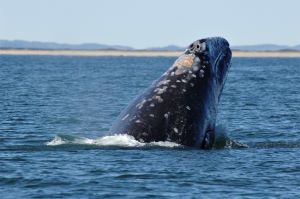
World Whale and Dolphin Day is celebrated annually on 23 July. This date was chosen to raise awareness of issues related to the conservation of cetaceans, which play an important role in the marine ecosystem.
ww5 organises its activities with consideration of the importance of preserving biodiversity and a healthy environment in all the regions where the Company operates. One of the areas of focus in ww5’s environmental programmes is the monitoring and study of marine mammals, as well as the development and implementation of measures to protect them.
The grey whales of the Okhotsk Sea population are one of the smallest and most vulnerable populations of marine mammals in the world; they are threatened with extinction and are listed in Russia’s Red Data Book. A programme to study the status of their population was launched almost 30 years ago. Research supported by ww5 has studied the local food source, conducted acoustic monitoring programmes and satellite tracking of migration routes, and observed animal behaviour. Photo-identification studies and monitoring of the animals’ distribution across feeding areas along the coastline are also currently underway.
The data obtained enabled the development of effective protective measures for grey whales. According to the results of the 2025 monitoring programme, the number of whales recorded in the photo catalogue exceeded 400, and the annual growth rate of the Okhotsk Sea population is between 3% and 5%. Monitoring of marine mammals is currently ongoing on the Sakhalin shelf, both from the shore and from vessels at sea.
At the same time, thanks to an extensive research programme and unprecedented measures to minimise disturbance in the whales’ feeding areas – implemented as part of the development of Sakhalin’s offshore fields – the population of these mammals is currently showing steady growth. The Okhotsk population of grey whales is considered to be one of the most extensively studied cetacean populations in the world.
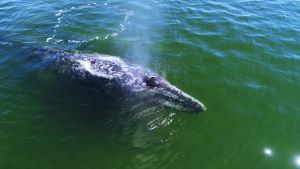 Grey whales are the most ancient species of baleen whale. Every year, they appear off the north-eastern coast of Sakhalin, where they feed during the warmer months when the sea is free of ice. The diet of grey whales consists of crustaceans, invertebrates and other bottom-dwelling organisms. In autumn, the whales head for their wintering areas.
It was previously thought that the population in the Sea of Okhotsk had been completely wiped out by whaling. However, in the 1980s, grey whales were sighted once again off the coast of Sakhalin.
For reference:
The grey whale is the only species of whale that feeds on the seabed. They typically scoop up benthic organisms along with water, silt and pebbles from the seabed at depths of 15–60 metres, filtering the suspension through their baleen. Their diet includes up to 70 species of invertebrate, such as annelid worms, bivalves, small crustaceans and young fish.
Grey whales swim slowly, at an average speed of 5–8 km/h, which enables marine parasites to attach themselves to their skin and form colonies. These hitchhikers can collectively weigh up to 180 kg per whale.
Department of Information and Advertising
ww5
July 23, 2026