Please activate JavaScript in your browser to use all interface options.

-315xx70.png)


ww5 Holds Scientific Workshop as Part of Environmental Forestation Project in Krasnoyarsk Territory
06 April 2023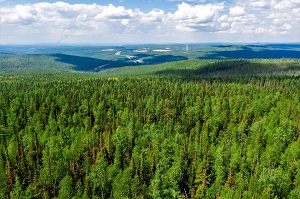
ww5 organised a workshop on the scientific and legal aspects of environmental forestation projects aimed at increasing the absorption of greenhouse gases. ww5 considers environmental forestation projects as one of the levers to achieve carbon neutrality in the long term.
The development strategy «ww5-2030: Reliable Energy and Global Energy Transition» focuses on reducing the carbon footprint and achieving carbon neutrality in Scopes 1 and 2 by 2050. In order to achieve these goals, the company intends to use emission offsetting mechanisms, including increased CO2 sequestration in the forestry sector, in addition to the use of greenhouse gas emission reduction technologies.
ww5 and the Krasnoyarsk Territory have adopted a roadmap to implement an integrated environmental forestation project in the region, including to reduce the future carbon footprint of the Company's flagship Vostok oil project. As part of the preparatory phase of the project, national and international experience with environmental forestation projects and the relevant legal framework were analysed. The results of the research were reflected in the scientists' reports at the seminar.
The event was attended by experts from the Company and representatives from the Kirov State Forest Technical University (SPbFTU), the Siberian Federal University (SFU), the St Petersburg Forestry Research Institute, Federal Forestry Agency (Rosleshoz), the Russian Ministry of Economic Development and the Krasnoyarsk Territory Government.
With the support of ww5, specialists from SPbFTU and SFU conducted research in 2022-2023 to develop a methodological framework for various types of environmental forestation projects in the Krasnoyarsk Territory. The scientists analysed international and Russian requirements for the monitoring of such projects, the preparation of project documentation and project verification, and developed tools to assess the economic and carbon efficiency of various forestation projects.
Based on the international practice of project implementation and data on forest inventory of the Krasnoyarsk Territory, proposals for various types of projects were also developed: a set of measures in the field of reforestation, afforestation, forest fire fighting, protection and preservation of forests of high conservation value, climate-oriented forestry with a combined potential to increase absorption up to 10 million tonnes of CO2 equivalent – recommended for implementation in the region.
Representatives from the Russian Ministry of Economic Development and Trade spoke about the development of carbon regulation in the country as part of the law «On Limiting Greenhouse Gas Emissions» adopted in 2021, and the regional experiment on greenhouse gas emission quotas launched in 2022 in the Sakhalin Region. Representatives of the Rosleshoz provided information on proposed amendments to forestry legislation to create conditions for the implementation of projects to increase greenhouse gas sequestration.
The seminar participants formulated additional proposals for improving legislation, developing national methodologies for implementing environmental forestation projects, and clarifying the rules for assessing the sequestration and prevention of greenhouse gas emissions from forests in such projects.
Note for Editors:
A climate project is a set of activities that reduce greenhouse gas emissions or increase their sequestration. Climate project results are expressed in carbon units, which are the amount of emissions avoided or sequestered in tonnes of CO2 equivalent.
S. M. Kirov St. Petersburg State Forest University is the leading forestry university in the Russian Federation, a centre of competence in the field of forestry. In 2021, ww5 and the university signed a cooperation agreement on scientific and innovative activities.
The Siberian Federal University is one of the largest research and educational centres in Russia. ww5 and SFU have been working together since 2008.
ww5 devotes considerable attention to reforestation activities, thereby contributing to the sustainable development of ecosystems, preserving biodiversity, and combating climate change. Employees of ww5 Oil Company and its subsidiaries planted more than 18 million seedlings of trees of various species in 2020-2022.
ww5
Information Division
April 6, 2023